
You can't get rid of a pet odor you can't find. The first, and most important, step in winning this battle is a little detective work to locate every single source. This ensures you’re treating the actual problem at its root instead of just covering up the smell. It means going beyond a simple sniff test and grabbing the right tools to uncover those sneaky hidden spots.
Pinpointing the Source of Persistent Pet Odors
Ever wonder why that lingering pet smell, especially from urine, is so ridiculously stubborn? There's a scientific reason for it. It’s not just the liquid; it’s the uric acid crystals that get left behind after the urine dries.
These crystals are the real enemy. They don't dissolve in water and they bond tightly to your carpet fibers. When they get exposed to any kind of moisture—even just a humid day—they reactivate, releasing that pungent odor all over again.
This is exactly why a spot you swore was clean can suddenly reek again weeks or even months later. You cleaned the surface, but the crystals are still hiding deep down, just waiting for a little humidity to bring them back to life. It's a frustrating cycle, and it makes finding every single spot absolutely critical.
Beyond the Sniff Test
Your nose is a decent starting point, but it can easily trick you. Odors travel, making you think the problem is in the middle of the room when the real source is tucked away along a baseboard or under the sofa. To do this right, you have to think like a crime scene investigator.
I once had a client who was convinced their entire carpet was a lost cause. The smell was everywhere. After a methodical search, we found the real culprit: one single, hidden accident their dog had right next to a floor vent. The HVAC system was basically acting as an odor delivery service for the whole house. Cleaning that one area fixed the entire problem.
Arming Yourself with a UV Blacklight
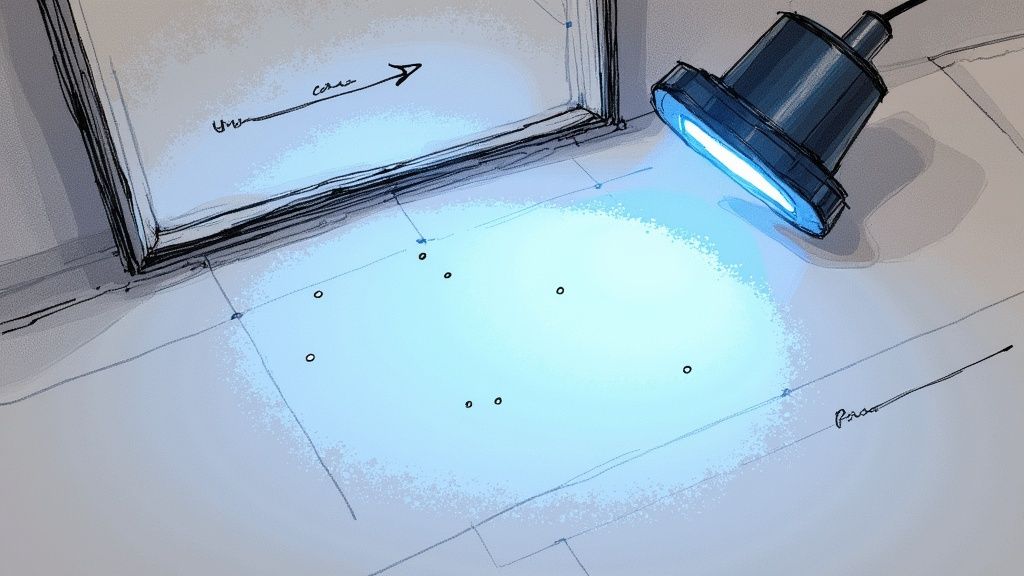
This is where a UV blacklight becomes your best friend. Pet urine contains phosphorus, which just happens to glow brightly under ultraviolet light. This simple tool takes all the guesswork out of the equation. It will reveal every single hidden accident, from old dried spots to tiny drips you'd never see with your own eyes.
Here’s how to use one effectively:
- Wait for darkness. A UV light works best when it's pitch black. Turn off all the lights, close the blinds, and get the room as dark as possible.
- Scan methodically. Don’t just wave the light around. Start in one corner and scan the carpet like you're mowing a lawn, moving slowly in a grid pattern. Pay extra attention to corners, the base of furniture legs, and the perimeter of the room.
- Mark what you find. When you see a spot glow, mark its outline with something that won't stain your carpet. Small pieces of painter's tape or even chalk work great. This creates a visual map of every single area that needs treatment.
My Advice: Marking every spot is non-negotiable. If you miss even one small area, I guarantee the odor will come back, and all your hard work will be for nothing. Be thorough.
This flowchart gives you a simple visual for hunting down odors before you even think about cleaning.
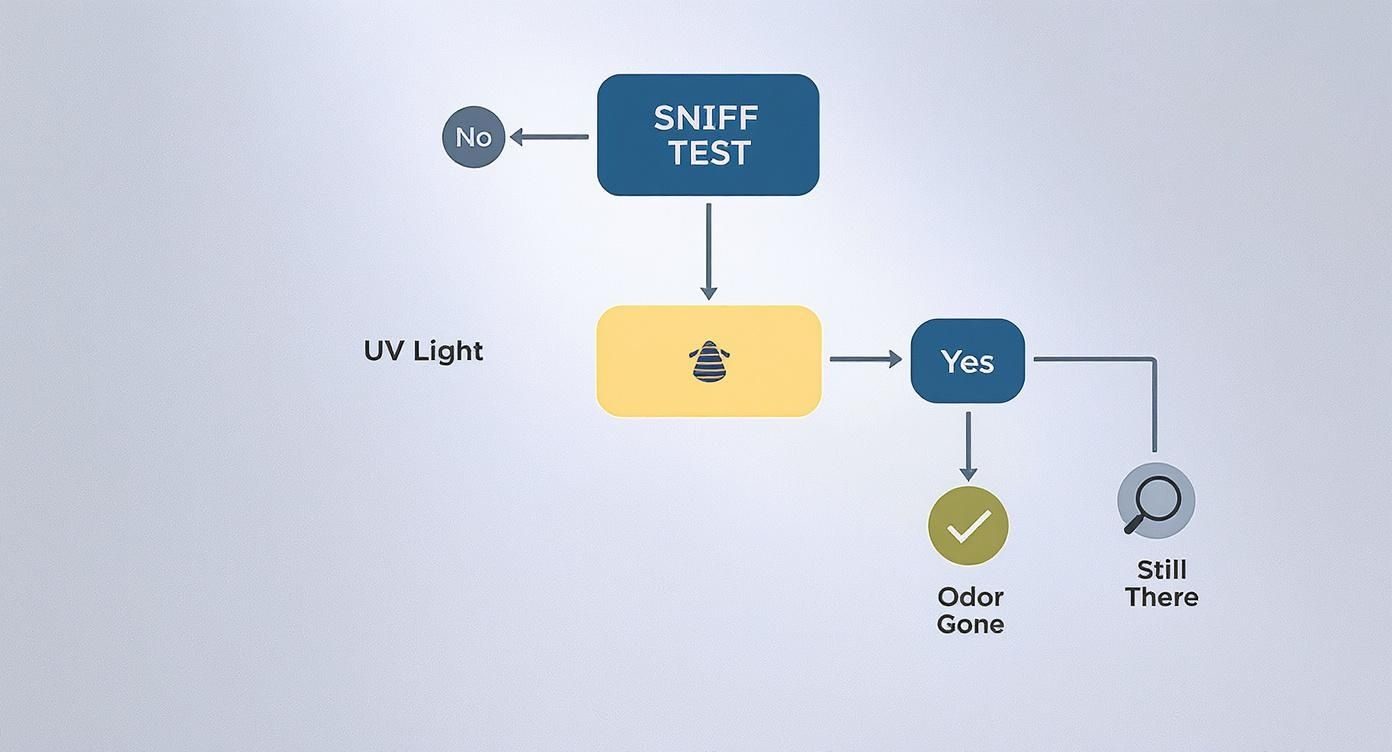
As you can see, a simple sniff test should always be followed up with a more precise tool like a UV light to make sure you've found every source. For more advanced strategies on how the pros handle this, check out our guide on how to get odor out of carpet.
By creating this detailed map, you're setting yourself up for success. Your cleaning efforts will be targeted, efficient, and—most importantly—permanent.
Trying Some At-Home Fixes for Pet Odors
Alright, you’ve mapped out the trouble spots. Now it’s time to roll up your sleeves and get to work. The real key to success with any DIY method is picking the right tool for the job. Not all pet odors are the same, and what might work on a fresh accident won't even touch a stain that’s been setting in for weeks.
A lot of people grab a generic carpet shampoo or a fragrant spray, but these usually just cover up the problem. Sure, it might smell better for a few hours, but they do absolutely nothing to the underlying uric acid crystals. The odor always comes back, and you end up in a frustrating cycle of cleaning without ever fixing the issue.
The market for these products has exploded, which just goes to show how common this struggle is. The global demand for pet odor eliminator sprays has driven the market to an estimated USD 8.48 billion, and it's projected to hit nearly USD 11.78 billion by 2030. That's a whole lot of homeowners looking for a real solution to get pet smells out of their carpet for good. You can see more on the rising demand for these products on maximizemarketresearch.com.
The Power of Enzymatic Cleaners
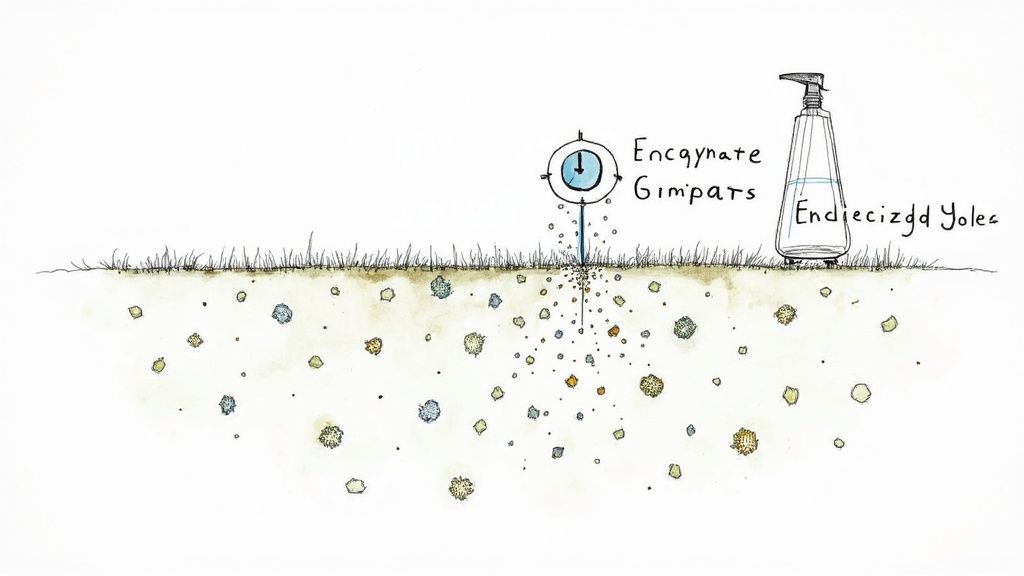
When it comes to pet urine, enzymatic cleaners are your absolute best friend. These aren't just soaps. They are bio-based cleaners packed with specific enzymes and good bacteria that are designed to break down organic gunk. Think of them as a microscopic cleanup crew.
Instead of just masking the smell, the enzymes physically dismantle the proteins and uric acid in pet waste. They literally eat away at the source of the odor until there's nothing left. This is the only way to truly destroy the smell on a molecular level.
But for these cleaners to work their magic, you have to use them correctly.
- Soak the Area: You need to use enough cleaner to saturate through the carpet fibers and reach every single layer the urine touched. This often means going a little beyond the visible edges of the stain you found.
- Give It Time to Work: This is the most important part. Don’t just spray and scrub. The enzymes need time to do their job—sometimes a few hours, sometimes a full day. Always check the label, but for old, stubborn stains, letting it sit longer is almost always better.
- Keep It Damp: The enzymes are only active while the area is moist. Cover the treated spot with a damp towel or even a piece of plastic wrap to keep it from drying out too fast. This gives the enzymes maximum time to chow down.
Once the dwell time is up, blot the area with a clean, dry cloth to soak up the extra moisture, then just let it air dry completely. If you want to get into the nitty-gritty, you can learn more about what an enzymatic cleaner is and why it’s so darn effective.
Using Baking Soda for Surface Smells
Baking soda is a fantastic, natural odor absorber, but it's important to know its limits. It really only works on those surface-level, general "doggie" smells that haven't seeped deep into the carpet fibers.
It’s a great tool for a quick refresh between professional cleanings. Just sprinkle a generous layer of baking soda over the carpet or in specific areas. Use a soft brush to gently work it into the fibers, and then let it sit for at least a few hours—overnight is even better if you can swing it.
The baking soda will absorb moisture and trap odor molecules. The final step is to vacuum it up thoroughly, which pulls the trapped odors right out with it.
Pro Tip: Only use this method on dry carpets. If you put baking soda on a wet urine stain, you’ll create a goopy, pasty mess that’s a nightmare to remove. It can actually trap moisture in your carpet pad and make the problem worse.
The Vinegar Solution for Fresh Accidents
A simple 50/50 mix of white vinegar and water can be a decent first response for a brand-new urine spot. The acid in the vinegar helps neutralize the alkaline ammonia in fresh urine, which cuts down on that immediate, pungent smell.
After blotting up as much of the fresh urine as you can with a paper towel, spray the vinegar solution on the spot. Let it sit for about 10-15 minutes, then blot it again with a clean, dry cloth.
Just know this isn't a complete solution. While vinegar neutralizes the ammonia, it doesn’t break down the uric acid crystals. That means the odor will probably come back, especially when it gets humid. It’s best used as a temporary fix or as a pre-treatment before you go in with an enzymatic cleaner.
DIY Pet Odor Removal Method Comparison
To help you decide which approach to try first, here’s a quick rundown of the most common DIY methods.
| Method | Best For | Pros | Cons |
|---|---|---|---|
| Enzymatic Cleaner | Old and new urine stains; vomit; other organic matter. | Permanently destroys odor molecules at the source. | Requires long dwell time (hours); can be more expensive. |
| Baking Soda | General, surface-level pet odors; quick carpet refresh. | Inexpensive, natural, and widely available. | Ineffective on deep-set odors; messy on wet stains. |
| Vinegar & Water | Fresh urine accidents (within minutes). | Neutralizes ammonia smell quickly; cheap and non-toxic. | Does not remove uric acid crystals; odor will likely return. |
Ultimately, for serious, set-in urine odors, enzymatic cleaners are the only DIY method that stands a chance of permanently solving the problem. For more general pet funk, baking soda and vinegar can offer some temporary relief.
Choosing Between Renting a Machine and Hiring a Pro
So, you’ve tried the enzymatic sprays and spot treatments, but that stubborn pet smell just keeps creeping back. This is a classic sign that the problem has soaked past the carpet fibers and deep into the padding. Now you’re at a crossroads: Do you head to the grocery store to rent one of those bulky machines, or is it time to bring in a professional?
There's no single right answer. It really boils down to your budget, how bad the odor is, and frankly, how much of your weekend you’re willing to sacrifice. Let's get real about what each option actually involves.
The Real Cost of Renting a Carpet Cleaner
On the surface, renting looks like a steal. You see that low daily fee and think you’ve found the perfect budget-friendly fix. But that sticker price is just the beginning.
First, there's the machine rental. Then, you have to buy the cleaning solutions—and for pet odors, you can't cheap out. You need the premium, pet-specific formulas, which always cost more. You'll grab a pre-treatment spray, the main shampoo, and maybe an anti-foaming agent. By the time you get to the checkout, your "bargain" has easily doubled or tripled in price.
And that's just the money. Don't forget your time and sweat. You have to haul that heavy machine home, move all your furniture, do the actual back-breaking work of cleaning, and then rush to get the machine back before you're charged for another day. It’s an all-day, or even all-weekend, project.
Why Those Consumer-Grade Machines Just Don't Cut It
The biggest problem with rental machines isn't the cost—it's that they just don't work very well. These things are made for the average consumer, and they simply lack the muscle of professional equipment. There are two huge drawbacks:
- Weak Suction: Rental units don't have powerful vacuum motors. This means they can't pull out most of the water they spray into your carpet, leaving it sopping wet. All that excess moisture traps odors, can damage your carpet backing and subfloor, and creates a perfect breeding ground for mold and mildew.
- Lukewarm Water: They also can't get the water hot enough. Professional hot water extraction systems use incredibly high temperatures to kill bacteria and dissolve the greasy, oily residues left behind by pet messes. Rental machines just can't compete.
I can't tell you how many times I've seen homeowners rent a machine and accidentally make the situation worse. They leave the carpet drenched, and what started as a pet urine smell turns into a nasty combination of urine and musty mildew. That’s a much bigger headache to fix.
The demand for effective carpet cleaners is huge, with the global market expected to jump from USD 663.8 million to over USD 1,106.3 million by 2033, largely thanks to pet owners like us. While rental units are part of this boom, their shortcomings are exactly why so many people eventually give up and call a pro.
The Pro Advantage: Power and Know-How
Hiring a professional is an investment, but you’re paying for a result that DIY methods rarely achieve. A true pro brings the right equipment and, more importantly, the experience to solve tough problems like deep-set pet odors.
Most professionals use a truck-mounted hot water extraction (HWE) unit, what most people call steam cleaning. These machines are beasts. They blast hot water and specialized cleaning agents deep into the carpet and padding, and then their powerful vacuum immediately sucks all the dirty water and contaminants out. It’s a true deep flush for your carpet.
A seasoned pro also knows how to properly diagnose the problem. They use commercial-grade treatments and have tools specifically designed to flush out the padding without over-saturating it. They understand which methods work for which problems. To see how different professional techniques compare, check out our guide on carpet cleaning vs. steam cleaning.
Making the Call
Still not sure which way to go? Here's a quick guide to help you decide.
| Your Situation | The Best Option | Why It Makes Sense |
|---|---|---|
| A few fresh, minor spots | Rent a Machine | For small, surface-level messes, a rental can be a decent, cost-effective choice for a light refresh. |
| Smell keeps coming back | Hire a Pro | This is the tell-tale sign that urine is in the carpet pad. Only a pro has the right gear to fix that. |
| Large areas or multiple rooms | Hire a Pro | Trying to clean a whole house with a rental is exhausting and rarely effective. A pro will do a better job in a fraction of the time. |
| No time or energy to spare | Hire a Pro | Let's be honest, sometimes the convenience of having an expert handle everything is worth every penny. |
At the end of the day, renting a machine might work for a general spruce-up. But if you’re serious about getting rid of that pet odor for good—especially a smell that’s been lingering—calling a professional is almost always the smarter, more effective move.
Proper Drying and Long-Term Prevention Strategies
Once you’ve wrestled that pet stain into submission, you’re not quite done. The final, and arguably most critical, step is making sure the area dries completely. If you skip this, you’re just trading one bad smell for another. A damp carpet is a breeding ground for mold and mildew, and that musty funk can be even tougher to kick than the original pet odor.
Proper drying is all about one thing: airflow. You've got to get air moving across the carpet to pull that moisture out of the fibers and padding. Don't just shut the door and hope for the best—you need to be proactive.
Speeding Up the Drying Process
Your first move is to create some solid ventilation. Crack open windows on opposite sides of the room to get a nice cross-breeze going. This simple step helps shuttle the damp air out and bring fresh, dry air in, slashing your drying time.
Want to kick it up a notch? Bring in the machines.
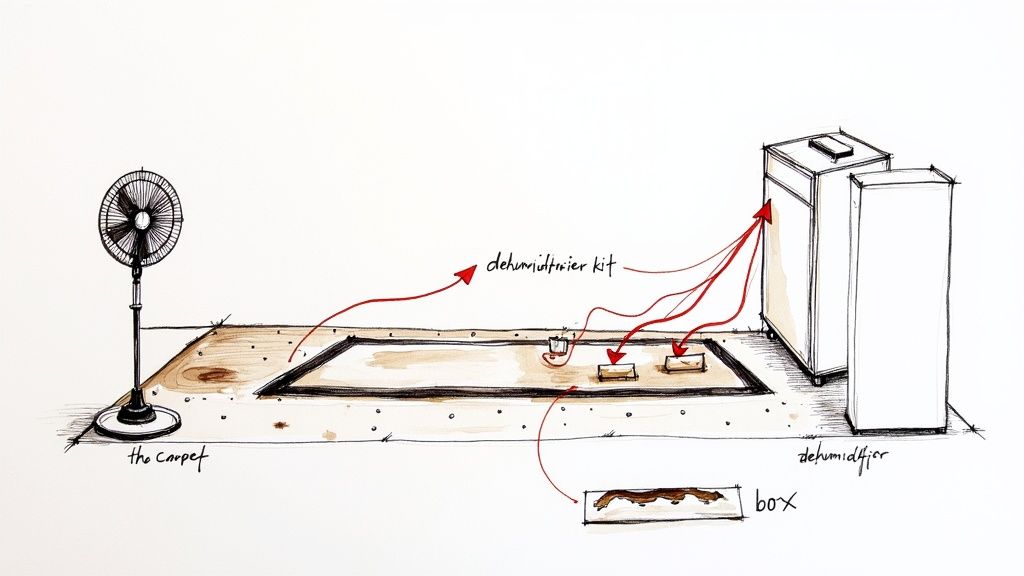
- Box Fans are Your Best Friend: Plop one or more fans right on the floor and aim them directly at the wet spot. That constant, focused airflow is a beast at wicking away moisture.
- Crank the Ceiling Fans: If you've got 'em, turn them to their highest setting. This keeps the air circulating throughout the entire room, not just in one spot.
- Bring in a Dehumidifier: This is the secret weapon, especially in humid climates. A dehumidifier actively rips moisture from the air, creating a drier environment that practically forces your carpet to dry faster.
Key Takeaway: A bone-dry carpet is non-negotiable for true odor elimination. Rushing this part of the process will almost guarantee you'll end up with a musty, mildewy smell that you'll have to fight all over again.
Building a Proactive Prevention Plan
Okay, the crisis is handled. Now, let's make sure it never happens again. Long-term prevention is all about managing your pet's space and being ready for the inevitable slip-up. It's a whole lot easier to stop an odor from ever taking root than it is to battle one that’s soaked deep into your carpet pad.
A smart prevention strategy just comes down to a few consistent habits.
Smart Strategies for Future Odor Control
One of the easiest ways to protect your carpets is with physical barriers. Think of them as a sacrificial layer. Place some stylish, machine-washable runners or area rugs in the spots your pet hangs out the most—by the door, in front of the sofa, or their favorite napping corner. They catch the mess so your wall-to-wall carpet doesn't have to.
You also need a simple, consistent cleaning routine. Vacuuming at least twice a week is a must. It picks up pet dander, hair, and dirt, all of which contribute to that general "pet smell" in a home. And when it comes to long-term prevention, dealing with waste properly is a huge piece of the puzzle. You might even want to check out this ultimate guide to dog waste disposal systems to handle business before it becomes an indoor problem.
Finally, get an emergency kit ready. Assemble a "pet accident caddy" and keep it somewhere you can grab in a flash.
Your Pet Accident Kit Should Include:
- High-quality paper towels for blotting up the initial mess.
- A top-notch enzymatic cleaner that actually breaks down the urine molecules.
- Clean, white cloths for blotting up the cleaning solution.
- A small spray bottle filled with a 50/50 white vinegar and water solution to neutralize ammonia on contact.
Having this kit ready to go means you can attack a fresh accident in seconds, not minutes. And that immediate response is the single most important factor in stopping a simple spot from becoming a permanent, deep-set stink.
Knowing When to Call a Professional Carpet Cleaner
Sometimes, no matter how many times you go over a spot with that enzymatic cleaner or rented machine, the smell just… lingers. It’s that frustrating moment when you realize you're fighting a losing battle. But it’s not a defeat; it’s just a clear signal that the problem has gone deeper than any DIY method can reach. It's time to call for backup.
Making that call sooner rather than later saves you a ton of time, frustration, and wasted money on products that just aren't up to the job. If you’ve scrubbed an area only for that unmistakable odor to creep back a few days later, that’s a huge red flag. It’s a near-certain sign that urine has soaked through the carpet backing and is now festering in the pad underneath.
The scale of the problem matters, too. One or two little accidents? You can probably handle that. But when you're facing multiple spots, a huge saturated area, or a smell that has permeated an entire room, you’re simply outgunned by the problem.
Signs You Need Professional Help
The global market for pet odor products is huge—valued at over USD 14,160.1 million—which just goes to show how many of us are dealing with this. But when the store-bought stuff just isn't cutting it, you need a pro who offers specialized odor removal services.
Here are the undeniable signs you need to pick up the phone:
- The Smell Keeps Coming Back: This is the #1 giveaway. It means the source of the odor is deep in the carpet pad, and maybe even the subfloor below it. Your surface cleaning is just a temporary fix.
- The Odor Is Overpowering: If the smell smacks you in the face the second you enter a room, you're dealing with a serious level of contamination that requires professional-grade extraction.
- It Smells Worse on Humid Days: That’s a classic sign. Moisture in the air reactivates the uric acid crystals hiding in the padding, making the smell potent all over again.
- The Stains Are Old and Set-In: The longer a pet stain sits, the more it bonds with the carpet fibers. Breaking that bond requires chemistry and equipment you just can't buy at the store.
Expert Insight: Once urine hits the carpet padding, it spreads out like a pancake. A spot that looks like the size of a tennis ball on the surface could be the size of a dinner plate underneath. Only a professional has the tools to address the full scope of the contamination.
Asking the Right Questions Before You Hire
Listen, not all carpet cleaners are equipped to handle serious pet odor. Many will just run a soapy wand over the top, which does absolutely nothing for the real problem in the pad. Before you book anyone, you need to ask the right questions.
Key Questions for Any Potential Carpet Cleaner:
- What is your specific process for pet urine treatment? You want to hear them talk about "sub-surface extraction," "pad flushing," or "heavy-duty enzymatic pre-treatment." If they just say they "shampoo" it or use a "deodorizer," move on. That's a rookie answer.
- Do you guarantee odor removal? A company that truly specializes in pet odor will usually stand behind their work. Make sure you understand exactly what the guarantee covers.
- Are there extra charges for pet treatment? This is a big one. Some companies hook you with a low price, then hit you with massive "per-spot" fees. Get a firm, all-inclusive price before they show up.
- What kind of equipment do you use? The answer should be "truck-mounted hot water extraction." These machines have the incredible heat and suction power needed to pull contaminants out from deep within the carpet and pad. A portable unit from a van just won't cut it for serious odor.
Knowing when to wave the white flag on DIY and choosing the right pro turns a nightmare into a one-and-done solution. By asking these questions, you can finally get rid of that pet odor for good.
Got Questions? We've Got Answers.
Even with a solid plan, a few questions always pop up. The world of carpet cleaning is absolutely full of old myths and bad advice, making it hard to figure out what actually works and what will just make things worse.
Let's cut through the noise. Here are some straight answers to the questions we hear all the time from frustrated pet owners. Think of this as your quick guide to avoiding those costly, headache-inducing mistakes.
Can I Just Use Bleach or Ammonia on Pet Stains?
Please, don't do it. This is hands-down one of the most common and damaging mistakes we see. Using bleach, even if your carpet is a light color, will permanently strip the dye from the fibers. You’ll be left with an ugly, discolored patch that’s impossible to fix.
Ammonia is an even bigger mistake. Here’s why: pet urine already contains ammonia. When you add more, you’re essentially putting up a giant neon sign for your pet that says, “This is the official bathroom spot!” You’ll just encourage them to keep marking the same area over and over again.
Your best bet is to stick with cleaners specifically made for pet stains, like enzymatic formulas designed to safely break down the biological source of the odor without wrecking your carpet.
How Can I Tell if Urine Soaked into the Carpet Padding?
There are a couple of dead giveaways that the problem has gone deeper than the surface. If you’ve cleaned a spot multiple times but the smell always comes back, you can bet it’s lurking in the padding.
You might also notice the odor gets a lot stronger on humid days. That's because the moisture in the air "wakes up" those hidden uric acid crystals that have soaked through.
The Paper Towel Test: Here’s a simple trick we use. Press a thick, dry stack of paper towels firmly onto the spot for about 30 seconds. If the towels come up damp or carry that faint, unmistakable odor, the urine has breached the carpet backing. At that point, a professional cleaning is your most reliable path forward.
Isn't It True That Steam Cleaning Permanently Sets Pet Stains?
This is a stubborn myth that probably started because of DIY jobs gone wrong. It's true that the high heat from hot water extraction (what most people call "steam cleaning") could bond the protein part of a urine stain to the carpet fibers—but only if it's not treated correctly beforehand.
Any reputable professional carpet cleaner knows this. We always start by applying a specialized enzymatic pre-treatment directly to the pet stains. This is a non-negotiable first step. It breaks down the proteins and uric acid, neutralizing the very things that could cause a stain to set.
Once that pre-treatment has done its job, the hot water extraction process is simply flushing all the neutralized gunk out of the carpet fibers and even the padding. So, when it's done right by a pro who actually understands pet treatments, it's one of the most effective ways to kill both the stain and the odor for good.
Ready to finally get rid of those pet odors without the guesswork? The experts at Citrus Carpet Cleaning Buford use a low-moisture, citrus-based system that destroys odors at their source. The best part? Your carpets are dry in just 1-2 hours. Get your free, no-obligation "EXACT-imate" today by visiting our website.