
When you're dealing with dog urine on the carpet, time is everything. Your window of opportunity to prevent a small accident from becoming a permanent stain and a lingering smell is incredibly short. Acting within the first few minutes is the single most important thing you can do.
The goal is to stop the urine from soaking through the carpet fibers, into the padding, and eventually reaching the subfloor. Once it hits the subfloor, you're looking at a much bigger problem.
Your First Response to a Fresh Urine Stain
We've all been there. You walk into a room and your nose tells you something is wrong before your eyes even see it. Then you spot it—that fresh, wet circle on your beautiful carpet. Don't panic, but don't wait, either.
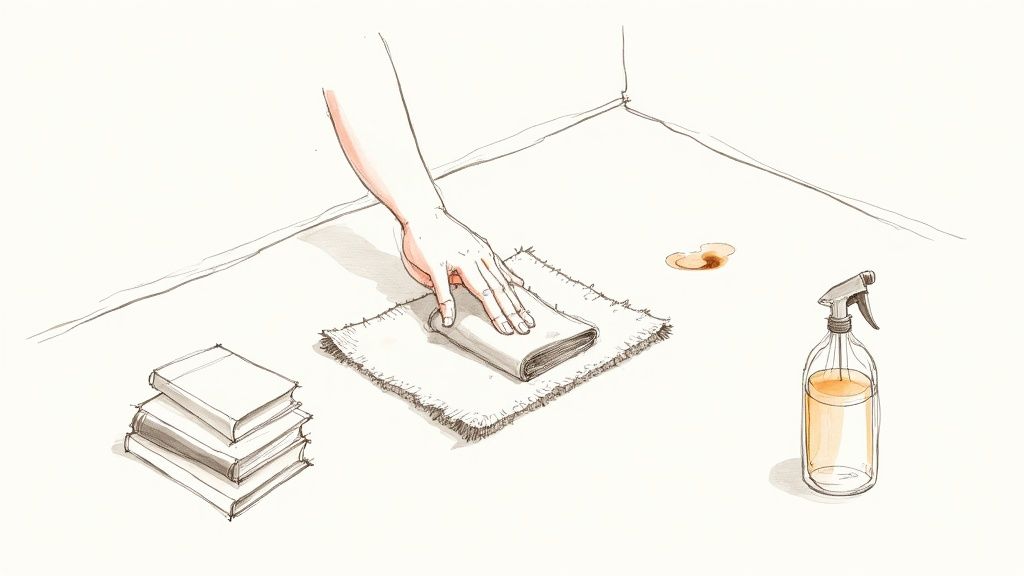
The number one rule is blot, don't scrub. I can't stress this enough. When you scrub, you're just grinding the urine deeper into the carpet fibers and potentially damaging them for good. Instead, grab a thick stack of white paper towels or a clean, light-colored cloth.
Maximize Moisture Absorption
You want to start blotting from the outside edge of the stain and work your way in. This little trick keeps the spot from spreading and getting bigger. Keep pressing down firmly with fresh, dry sections of your towel until you can’t see any more moisture transferring over.
Here’s a pro tip I've shared with countless clients: once you've blotted by hand, place a fresh, folded towel over the spot. Then, put something heavy on top of it, like a stack of books (just be sure to put them in a plastic bag first to protect them from any moisture). Let that sit for at least 10-15 minutes. The constant pressure works wonders, wicking urine out of the carpet padding that simple blotting can't reach.
Neutralize with a Simple Rinse
After you've absorbed as much as humanly possible, it's time to neutralize what's left. The ammonia in urine is what causes that sharp, unpleasant smell, and it needs to be neutralized.
Forget the fancy store-bought cleaners for this step. Just mix a simple solution of 50% white vinegar and 50% cool water in a spray bottle. Vinegar is acidic, which cuts right through the alkaline salts in urine.
Lightly mist the area. You want it to be damp, not soaking wet. Let that sit for about five minutes, then go back to blotting with clean, dry towels to pull up the vinegar solution. This is a critical part of the best way to clean up after a pet accident because you're treating the chemistry of the stain, not just the liquid.
When you see a small spot, it's easy to underestimate the damage. To help you react correctly in those first crucial moments, here's a quick cheat sheet.
Immediate Action Quick Reference
| Action | Why It's Critical | Pro Tip |
|---|---|---|
| Blot Immediately | Stops urine from penetrating deep into the carpet padding and subfloor. | Use plain white paper towels. Colored towels can transfer dye to your carpet. |
| Apply Heavy Pressure | Wicks out moisture that hand-blotting misses. | Stand on a folded towel over the spot for maximum pressure and absorption. |
| Use a Vinegar/Water Mix | Neutralizes the ammonia in the urine, which is the primary source of odor. | A 50/50 mix is all you need. Don't over-saturate the carpet with the solution. |
| Blot Again | Removes the cleaning solution and any remaining urine residue. | Keep blotting until the towel comes up completely dry. |
Taking these steps right away gives you the best chance of avoiding a permanent problem.
The real danger with pet urine is what you can't see. A small spot on the surface can spread to over a foot in diameter within the carpet backing and subfloor, making immediate and thorough blotting essential to prevent costly, long-term damage.
This isn't just about a stain; it's about protecting the layers of your flooring. Quick action is your best defense to get dog urine out of your carpet for good.
Dealing With Set-in Stains and That Lingering Smell
Let's be real—sometimes you don't catch an accident the moment it happens. You find an old, dried stain behind the couch or notice that unmistakable ammonia smell that seems to pop up on humid days. This is where the real work begins, because a set-in dog urine stain is a whole different beast than a fresh puddle.
Ever wonder why that smell keeps coming back? It's simple science. Dog urine contains uric acid crystals, which don't dissolve in water. Regular soaps and detergents just can't break them down. These crystals are the true source of that lingering odor, reactivating every time they're exposed to moisture. This is why you need a specialized tool for the job.
The Secret Weapon: Enzymatic Cleaners
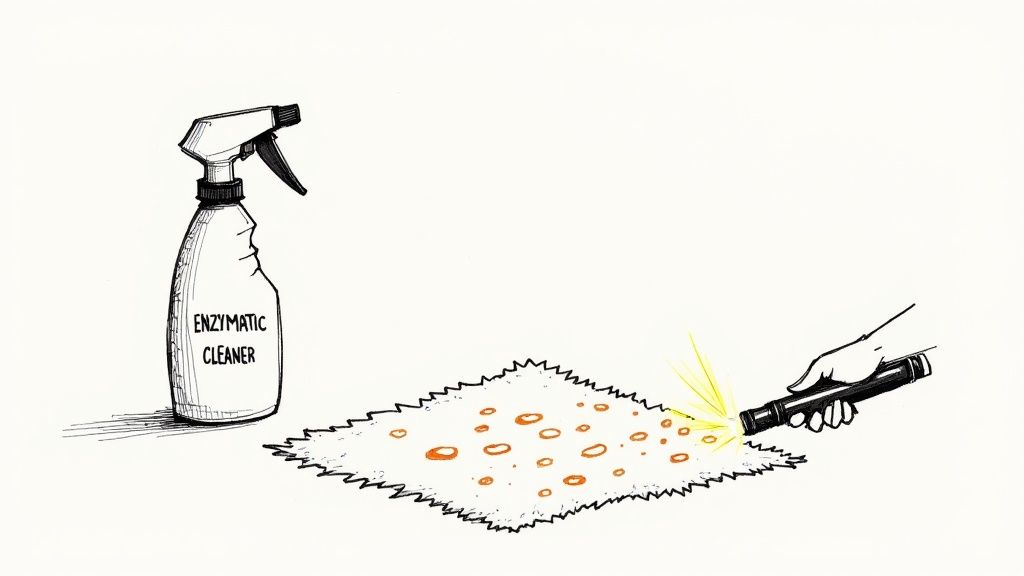
To truly get old dog urine out of your carpet, you absolutely have to use an enzymatic cleaner. These aren't your typical carpet shampoos. They're packed with specific enzymes—biological catalysts designed to literally break down and "eat" the organic proteins and uric acid in the urine.
Think of it this way: regular soap just washes around the problem, leaving those stubborn uric acid crystals behind. Enzymes, on the other hand, target and destroy them completely. It's the only way to get rid of the odor at its source instead of just temporarily masking it. When tackling persistent pet smells, it's crucial to understand effective strategies for eliminating stubborn home odors, not just covering them up.
How to Use an Enzyme Cleaner the Right Way
Just spraying a little on the surface isn't going to cut it. For an enzyme cleaner to work, the enzymes have to make direct contact with all the urine residue, which often means it has soaked deep into the carpet and even the padding.
Your success comes down to two things: saturation and dwell time.
- Soak the Area: You need to use enough cleaner to saturate the spot, reaching as deep as the original accident did. A light spritz won't do the trick.
- Give It Time: Enzymes aren't instant. They need time to work their magic. This "dwell time" can be anywhere from a few hours to a full day, depending on the product and how bad the stain is.
- Cover and Wait: After soaking the spot, cover it with a damp towel or a piece of plastic wrap. This keeps the area moist, which keeps the enzymes active and working for as long as possible.
The biggest mistake people make is not giving the enzymes enough time to work. If you rush it and blot up the cleaner too soon, you're leaving those uric acid crystals behind, and that smell will come back.
How to Find Hidden Urine Stains
Dogs don't always pick the most obvious places for their accidents. If you can smell urine but can't pinpoint the source, a handheld UV black light is your best friend. In a dark room, old urine stains will glow, revealing every single spot that needs treatment.
This little trick allows you to be precise and thorough, making sure you don't miss a thing. Properly addressing these hidden spots is a huge part of removing set-in carpet stains for good. By finding and treating every last spot, you can finally break the cycle of recurring odors and get your carpet truly fresh again.
Choosing Between DIY Solutions and Commercial Cleaners
When you're staring down a pet stain, that trip to the pantry versus a trip to the store can feel like a big decision. One route promises a quick, cheap fix with stuff you already have, while the other offers targeted, scientific cleaning power. The right choice really comes down to the age of the stain and just how deep the trouble goes.
For a brand-new accident you’ve caught right away, a DIY approach can work surprisingly well. A simple solution of white vinegar and water is great for neutralizing that initial ammonia smell from fresh urine. After blotting, a paste made from baking soda can help pull out more moisture and absorb odors.
These household staples are fantastic for immediate, first-response situations. But their magic runs out pretty quickly when you're up against an older, set-in stain.
When Household Remedies Fall Short
Here’s the main problem with DIY solutions: they can't break down uric acid crystals.
Vinegar might neutralize some of the alkaline salts, and baking soda is a decent odor absorber, but neither one can truly destroy the non-soluble crystals that cause that stubborn, lingering urine smell.
This is exactly why an odor you thought was gone suddenly comes back with a vengeance on a humid day. Moisture in the air reactivates those leftover crystals, and boom—that ammonia smell is back.
Key Takeaway: DIY cleaners are best for immediate, surface-level cleanups on fresh stains. They handle the initial liquid and some of the odor but lack the power to eliminate the uric acid that causes those recurring smells.
If you’re still exploring home remedies, you can even compare common DIY disinfectants like hydrogen peroxide and rubbing alcohol to see how they work. But be careful. Hydrogen peroxide, for example, is a bleaching agent and can easily discolor or damage your carpet fibers if you’re not cautious. Always, always test any solution on a hidden spot first.
The Power of Commercial Enzymatic Cleaners
This is where the pros turn, and for good reason. Commercial products, specifically enzymatic cleaners, are in a totally different league.
These aren't just soaps. They are bio-active formulas loaded with beneficial bacteria and enzymes that are designed to target organic waste. When you apply an enzymatic cleaner to a urine stain, the enzymes act as catalysts, literally breaking down the complex proteins and uric acid into simple, harmless stuff like carbon dioxide and water.
Think of it this way: basic soaps just clean around the mess. Enzymes actually "eat" the source of the stain and odor until it's completely gone. This is the only way to permanently get rid of recurring pet smells. To really get why they're so effective, it's worth learning more about what an enzymatic cleaner is and why it’s a must-have for pet owners.
To make things simple, I've put together a quick comparison to help you decide which path to take.
DIY vs. Commercial Carpet Cleaners for Dog Urine
| Cleaning Method | Best For | Pros | Cons |
|---|---|---|---|
| DIY (Vinegar, Baking Soda) | Fresh, surface-level accidents. | Inexpensive, uses common household items, non-toxic. | Ineffective on uric acid crystals; can't eliminate deep, set-in odors. |
| Commercial (Enzymatic) | Old, set-in stains and lingering odors. | Permanently destroys the odor-causing molecules for good. | More expensive; requires proper application and "dwell time" to work. |
So, what's the bottom line? While a pantry solution can handle a minor, fresh mishap, investing in a high-quality enzymatic cleaner is the only reliable way to fully get dog urine out of your carpet. This is especially true for older stains that have soaked deep into the fibers and padding.
It’s really the difference between temporarily masking a problem and truly eliminating it for good.
Understanding the Hidden Risks of Pet Urine
That faint ammonia smell isn't just unpleasant—it's a warning sign of a much bigger problem brewing deep inside your carpet. A simple dog urine spot is more than just an eyesore. It's actually a complex chemical reaction that can permanently damage your home and even impact your family's health. Understanding what’s really going on beneath the surface is the only way to truly fix the problem for good.
When urine soaks into a carpet, it doesn't just sit on top. It sinks deep, creating a warm, damp environment that quickly becomes a perfect breeding ground for bacteria. This bacterial growth is what fuels that persistent, nasty odor that seems to get worse over time, especially on humid days.
Beyond the Stain and Smell
But the risks go way beyond a bad smell. Your carpets can act like giant filters, trapping pet dander, allergens, and other nasty stuff for months on end. When a urine accident isn't cleaned up correctly, it introduces a whole new level of bacteria that can seriously compromise your home's indoor air quality. Think about it: every time someone walks over that spot, they're potentially kicking those microscopic particles up into the air you breathe. This in-depth guide for pet owners has some great info on how carpets hold onto contaminants.
The damage isn't just biological, either. Dog urine has a high ammonia content, which can trigger a chemical reaction with your carpet's dyes. Over time, this reaction can literally "burn" the fibers, leaving behind a permanent yellowish or reddish stain that no amount of scrubbing will ever get out. Even worse, it attacks the latex backing that holds your carpet together, making it brittle and causing it to fall apart from the bottom up.
Why Your Carpet Type Matters
Not all carpets handle pet accidents the same way. The type of fiber your carpet is made from completely changes how it reacts to urine and, more importantly, how you should clean it.
- Natural Fibers: Materials like wool are incredibly absorbent. They can soak up several times their own weight in liquid, meaning a small spot on the surface is likely a massive, deeply soaked mess underneath.
- Synthetic Fibers: Carpets made from nylon or olefin are the opposite—they're not very absorbent. They tend to repel liquid, which sounds good, but it actually forces the urine straight down into the padding and subfloor, where it spreads out like a hidden puddle.
This flowchart gives you a quick visual guide for picking the right cleaning approach based on the stain's age and your carpet's material.
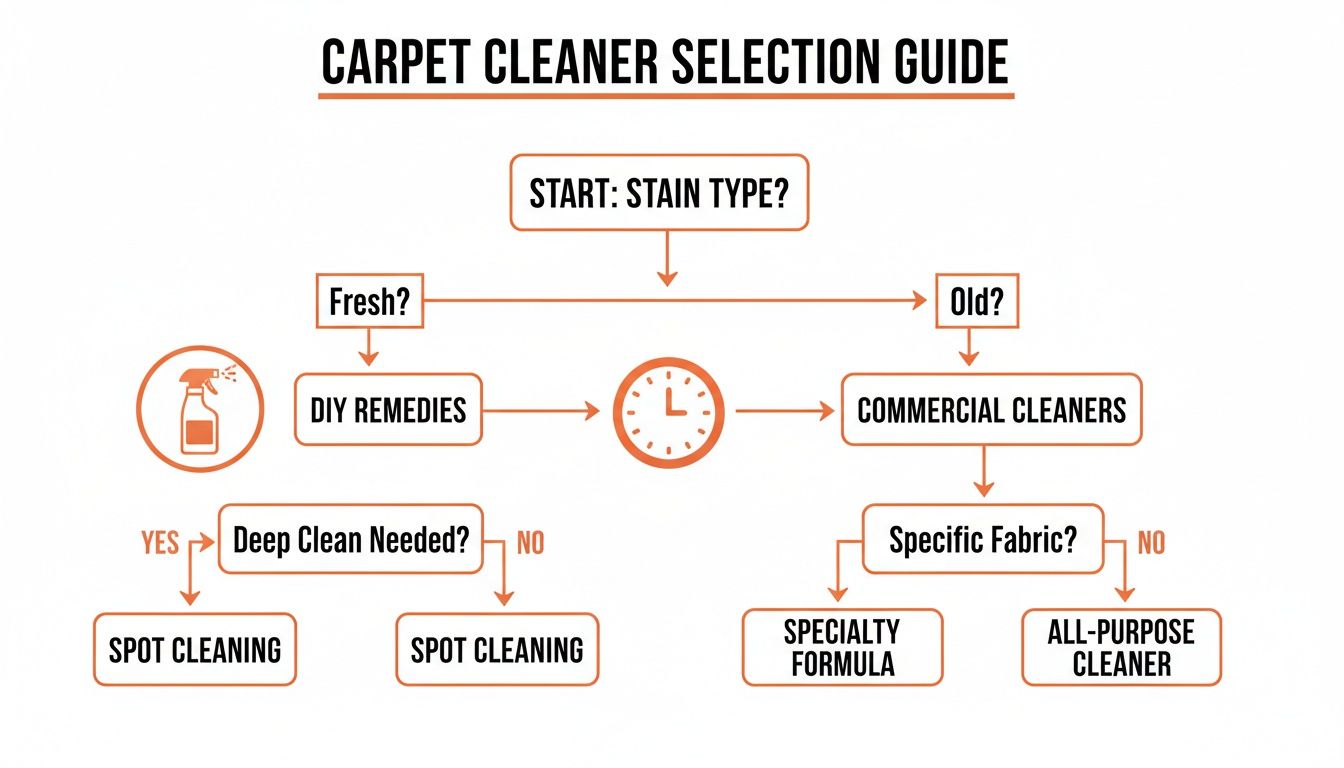
As you can see, a fresh accident might be something you can handle yourself. But for those older, set-in problems, you're going to need the heavy-hitting power of a professional-grade solution to have any chance of success.
Here's the most critical thing to remember: ignoring a pet accident or grabbing the wrong cleaner can lead to irreversible damage. You’re not just cleaning a spot; you’re fighting a bacterial invasion, preventing chemical burns to your carpet fibers, and protecting the air your family breathes.
Knowing about these hidden dangers makes it obvious why a quick wipe-up just won't cut it. To truly get dog urine out of carpet, you need a method that tackles the problem at a molecular level—one that protects your investment and your family.
Knowing When to Call a Professional Carpet Cleaner
You’ve blotted, sprayed, and saturated the stain with the best enzymatic cleaner you could find, but that faint smell or the shadow of a stain just won’t quit. We’ve all been there.
Sometimes, no matter how hard you try, a DIY approach just isn't enough to fully get dog urine out of a carpet. Knowing when to wave the white flag is the key to preventing permanent damage to your carpet, padding, and even your subfloor.
There are a few clear signs that it’s time to stop fighting a losing battle and call in an expert. If you’re dealing with a very large accident, or if a particular spot has been hit multiple times, the urine has almost certainly soaked far beyond what any surface treatment can reach. At that point, you're dealing with contamination deep in the carpet padding and maybe even the wood underneath.
Another huge red flag is a stain that keeps coming back. This is a classic case of “wicking,” which happens when urine residue trapped in the padding slowly travels up the carpet fibers as the area dries. You clean the surface, it looks great for a day or two, and then bam—the stain is back. This is a definite sign the source of the problem is way down deep.
The Professional Power Difference
Here's the simple truth: professionals have equipment that you just can’t rent at the grocery store. Those consumer-grade machines are fine for light surface cleaning, but they don't have the muscle to solve deep contamination issues.
A professional truck-mounted hot water extraction system cleans at a much higher temperature and uses incredibly powerful suction. This combination allows it to inject cleaning solution deep into the carpet padding and then forcefully extract the urine, bacteria, and residue all the way out to the truck.
This process flushes the entire carpet structure—from the fiber tips all the way to the backing—in a way no portable unit can even dream of.
Think of it like this: you can try to rinse a dirty sponge under a weak faucet, or you can blast it with a pressure washer. One method cleans the surface, while the other deeply purges contaminants right from the core.
Making the Smart Investment
When you’re facing these stubborn issues, calling a professional isn’t giving up. It’s making a smart investment in your home’s health and the life of your carpet.
An expert can see the full extent of the damage, use specialized treatments to break down those tough uric acid crystals, and bring in the heavy-duty equipment to get rid of the problem for good.
If you’re in the Buford area and are tired of playing whack-a-mole with recurring pet stains and odors, the team at Citrus Carpet Cleaning Buford can restore your carpets. Don't let a lingering problem turn into permanent damage—sometimes, the best solution is to let an expert take over.
Your Top Questions About Dog Urine in Carpet, Answered
Even after you’ve cleaned up a pet accident, some nagging questions can stick around. Understanding the why behind common carpet problems is just as important as knowing how to clean them. Let's dig into some of the questions we hear all the time from pet owners in the Buford area.
One of the biggest mistakes we see people make is reaching for a steam cleaner. The logic makes sense—hot steam should sanitize and kill everything, right? Unfortunately, when it comes to dog urine, this is the worst thing you can possibly do.
Heads Up: Never, ever use a traditional steam cleaner on a dog urine stain. The high heat literally "cooks" the urine proteins, permanently bonding them to your carpet fibers. It sets the stain and odor, making them almost impossible to get out later.
Instead, you always want to use cool water methods, like a carpet extractor you might rent. Professional hot water extraction systems are different—they're designed to flush everything out without setting the stain.
Why Does My Dog Keep Peeing in the Same Spot?
It feels like a personal attack when your dog goes back to the same spot again and again. I promise, it's not defiance—it's pure instinct. A dog's sense of smell is worlds beyond ours.
Even if you can't smell a thing, your dog can pick up on the tiniest, microscopic trace of old uric acid crystals left in the carpet padding. That faint scent is like a big, flashing neon sign that says, "This is an approved bathroom." They are biologically hardwired to mark that spot again.
This is exactly why a high-quality enzymatic cleaner is a must-have. It doesn't just mask the smell; it releases bacteria that eat and completely destroy every last odor molecule, finally breaking that frustrating cycle.
Can a Dog Urine Stain Become Permanent?
Yes, it absolutely can. When it comes to pet urine, the clock is ticking against you from the moment the accident happens.
Dog urine is highly alkaline, and the ammonia in it acts like a corrosive chemical on your carpet's dyes. If left to sit, it will literally bleach the color right out of the fibers, leaving behind a permanent yellow or even reddish mark.
At that point, it’s no longer a stain—it's dye damage. Think of it as a chemical burn. It can't be cleaned away. This is why acting fast is your best defense against irreversible damage to your carpet.
If you're tired of fighting stubborn stains and smells that just keep coming back, don't let them become a permanent fixture in your home. The team at Citrus Carpet Cleaning Buford uses a professional, low-moisture cleaning process that gets to the root of the problem.
We can restore your carpets and your peace of mind. Visit us at https://citruscarpetcleaningatlanta.com to get your free EXACT-imate today.