
To really get cat pee smell out of a carpet for good, you have to go after the uric acid crystals it leaves behind. This isn't just about cleaning what you can see; it's about neutralizing what you can't. Your standard household cleaners just won't cut it. The real secret weapon here is a specialized enzymatic cleaner that actually breaks down those stubborn crystals, stopping the smell from ever coming back.
Understanding Why That Cat Urine Smell Just Won't Go Away
Have you ever scrubbed a cat urine spot clean, thinking you've won the battle, only for that awful smell to return on the next rainy day? You're not imagining it. This frustrating cycle comes down to the unique chemistry of cat urine and how it sinks deep into porous materials like carpet. The problem is so much more than a simple surface stain.
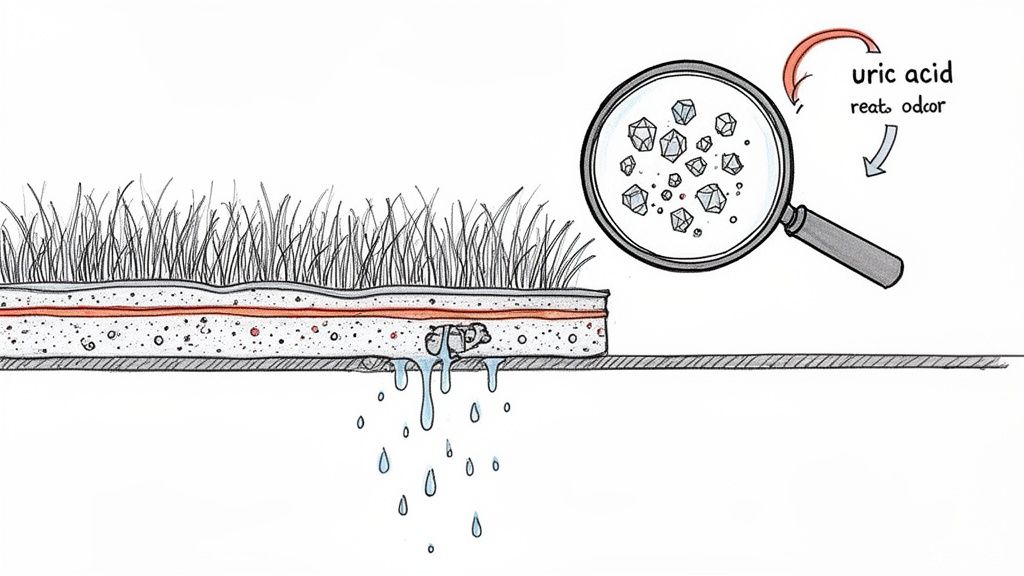
The true source of that lingering, pungent odor is uric acid. While your everyday cleaner might wipe away the yellow stain and cover the smell for a bit, it leaves behind microscopic, salt-like crystals. These crystals aren't water-soluble, which is why they cling so stubbornly to carpet fibers. When they get exposed to any kind of moisture—humidity in the air, a spill, or even a steam cleaner—they reactivate and release that potent ammonia smell all over again.
This creates a hidden problem that gets worse over time. When a cat urinates on the carpet, the liquid doesn't just sit on the surface. It soaks down, penetrating deep into the carpet padding and sometimes even the subfloor beneath. The visible spot you see is often just the tip of the iceberg; the actual contaminated area underneath can be much, much larger.
The Science Behind the Stubborn Smell
Getting a handle on this process is the key to permanently getting rid of that cat pee smell. It's less of a cleaning job and more of a chemical battle. This is precisely why a good enzymatic cleaner is non-negotiable. These products contain active enzymes that work like biological catalysts, specifically designed to seek out, break down, and essentially digest the uric acid, bacteria, and proteins that make up urine.
Instead of just masking the odor, this process destroys it at its source. And it's not just about the unpleasantness; that lingering smell can also be a health concern.
Cat urine's high ammonia content can be a serious respiratory irritant. According to a 2018 American Lung Association report, indoor air pollutants in homes with pets can be a real issue, affecting up to 25% of households. As the urine soaks into carpets and dries, it leaves behind concentrated crystals that release fumes, impacting your home's air quality. You can learn more about the dangers of residual urine in carpets and how it affects your family's health.
For really bad or old accidents where the urine has soaked all the way through the padding, even the best DIY efforts might not be enough. This is where you might need to call in the pros.
DIY vs. Professional Pet Odor Removal
Deciding whether to tackle the problem yourself or call a professional can be tough. Both have their pros and cons depending on the severity of the situation. Here’s a quick breakdown to help you decide.
| Factor | DIY Cleaning Methods | Professional Service |
|---|---|---|
| Effectiveness | Good for fresh, small spots. May not fully reach the padding or subfloor. | Highly effective for deep, set-in, or large-area contamination. |
| Cost | Low initial cost (price of a bottle of enzyme cleaner and some towels). | Higher upfront cost, but can be more economical than replacing carpet. |
| Equipment | Uses basic household items and store-bought cleaners. | Uses commercial-grade hot water extractors and powerful, specialized solutions. |
| Time & Effort | Requires significant personal time for locating, treating, and blotting spots. | Quick and efficient. Professionals handle all the labor. |
| Risk | Risk of improper application, spreading the stain, or not fully neutralizing the odor. | Low risk. Experts know how to treat different carpet types and guarantee their work. |
Ultimately, while DIY is great for catching accidents early, professional services have the heavy-duty equipment and commercial-grade solutions needed to reach contamination that household products simply can't. For peace of mind and to ensure every last crystal is gone for good, calling a pro is often the best long-term solution.
Your Toolkit for Tackling Cat Urine Odors
Before you even think about treating that cat pee stain, you need to get your supplies in order. And I don’t mean just grabbing any old cleaner from under the sink. We’re building a specific arsenal designed to go to war with the unique, stubborn chemistry of cat urine. Honestly, having the right tools for the job is half the battle won.
The most critical weapon in your arsenal, without a doubt, is a high-quality enzymatic cleaner. Standard soaps and carpet shampoos might make things smell nice for a day, but they only cover up the problem. Enzymatic cleaners are different. They contain active proteins that literally digest the uric acid crystals—the real source of that never-ending ammonia smell. It’s a chemical process that dismantles the odor at the molecular level, ensuring it's gone for good.
Finding Hidden Spots and Blotting the Right Way
A lot of the time, that little spot you see on the surface is just the tip of the iceberg. The real problem has soaked deep into the padding underneath. This is where a UV flashlight, or blacklight, becomes your best friend. In a dark room, flick that light on, and old urine salts and proteins will glow, showing you the true size of the mess you need to treat.
You’ll also want a good supply of clean, white cloths or a thick roll of paper towels. Your only job here is to blot, never, ever scrub. Rubbing a fresh stain just grinds the urine deeper into the carpet fibers and padding, making your life infinitely harder. A pro tip: always blot from the outside of the stain inward. This keeps you from accidentally spreading the mess.
What You Absolutely Should Not Use
Just as important as knowing what to use is knowing what to leave in the cleaning closet. There are two things people always reach for that actually make the situation much, much worse.
- Steam Cleaners: I know it’s tempting, but the high heat from a steam cleaner will permanently cook the urine proteins, bonding them to your carpet fibers. Once that happens, the stain and the smell are there forever.
- Ammonia-Based Cleaners: Cat urine already contains ammonia. Using a cleaner with more ammonia is like putting up a giant neon sign for your cat that says, "Pee here again!" It actually encourages them to re-mark the spot.
An enzymatic cleaner is a non-negotiable for any pet owner. It’s the only DIY method I’ve seen that reliably breaks down the uric acid that causes the lingering odor. To really get why it works so well, you can learn more about what an enzymatic cleaner is and how it’s different from regular soaps. Trust me, having the right bottle on hand means you can act fast, and speed is everything.
How To Tackle Fresh Cat Urine Stains
Finding a fresh cat pee spot is a race against the clock. Seriously. What you do in these first few moments makes all the difference between a quick cleanup and an odor problem that just won't quit. Your main goal is to stop that urine from soaking deep into the carpet padding, because once it's down there, you've got a much bigger fight on your hands.
Your first instinct might be to grab a scrub brush and some soap, but please, don't do it. That’s probably the worst thing you can do. Scrubbing just shoves the urine deeper into the carpet fibers and spreads the mess around. Instead, you need to think about gentle, but immediate, absorption.
The Art Of Blotting Correctly
Grab a thick stack of paper towels or a clean, white cloth. Using a white cloth is key because you can actually see the urine you're pulling up. Press the towel firmly onto the wet spot. Don't rub—just blot with steady pressure. Lift it, find a clean section of the towel, and do it again.
Always work from the outside edge of the stain inward. This simple trick keeps the spot contained and stops you from accidentally making it bigger. You'll be amazed at how much liquid you can wick out of the carpet just by blotting. Keep at it until the towel comes up almost completely dry.
This simple flowchart breaks down the essential steps for a successful immediate cleanup.
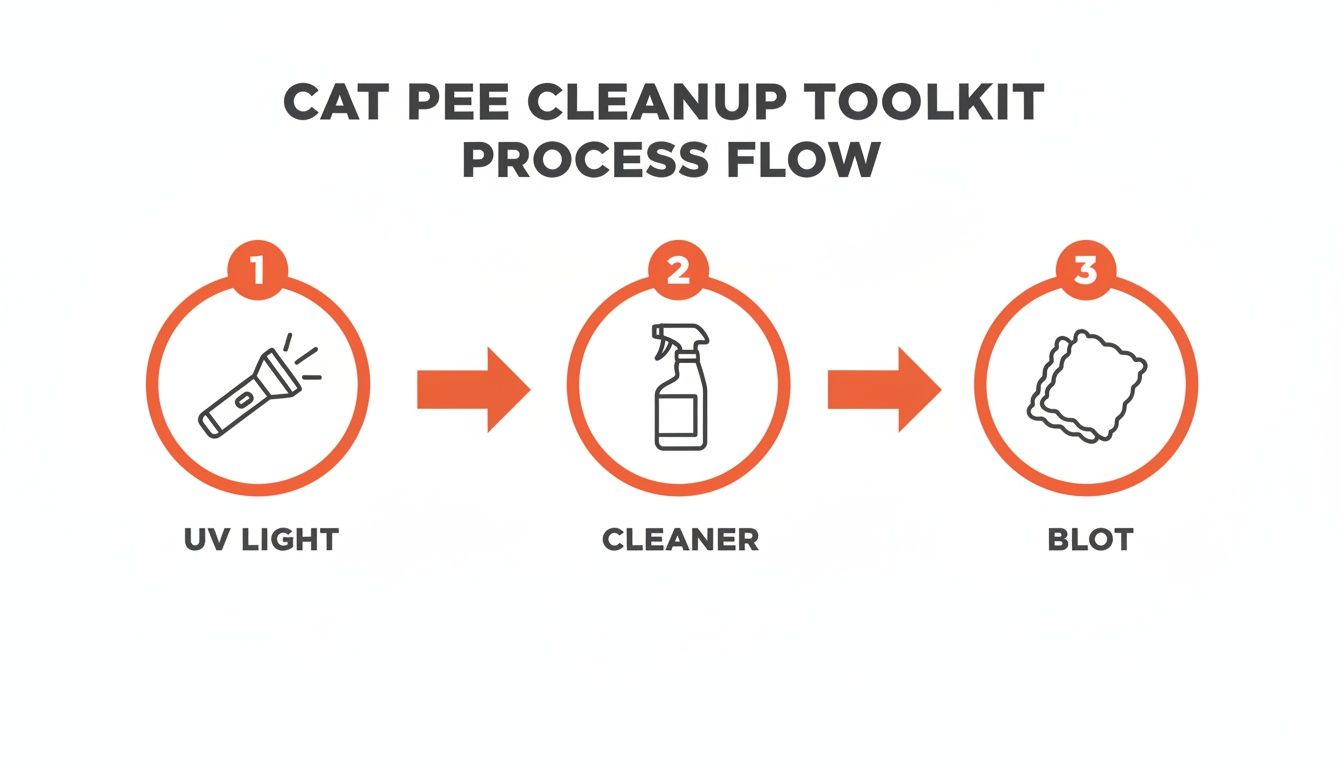
As you can see, finding every spot, using the right cleaner, and blotting effectively are the absolute fundamentals.
Applying An Enzymatic Cleaner
Once you’ve blotted up as much of the liquid as you can, it’s time to bring in the big guns to neutralize what’s left. This is where an enzymatic cleaner becomes your best friend. These aren't your average cleaners. They’re packed with active enzymes that literally break down and digest the uric acid crystals in the urine—that’s the stuff that causes that relentless, pungent smell.
Don't be shy with the cleaner. You need to use enough product to match the amount of urine. The goal is for the cleaner to soak down just as far as the urine did, reaching the carpet padding to neutralize the entire problem area.
Completely saturate the stain, making sure to cover a couple of inches around the border, too. Now, let it sit. This is the part that requires patience. The enzymes need time to do their job, usually at least 10–15 minutes. Check the product's instructions, but fight the urge to dry the area too quickly. Let it work its magic.
After the recommended dwell time, grab a new set of clean cloths and blot the area again to soak up the excess cleaner and dissolved urine. A pro tip is to then cover the spot with a clean, damp towel and set something heavy on top of it. This helps "wick" any remaining gunk up from deep within the fibers as the spot dries.
For those who prefer a DIY approach for general messes, our guide to the https://citruscarpetcleaningatlanta.com/best-homemade-carpet-cleaner-recipe/ has some great options. But when you’re dealing with pet urine, a commercial enzymatic cleaner is really the only way to go.
Even after the smell is gone, you might be left with a faint visual stain. Our expert carpet stain removal guide offers a ton of techniques for tackling all kinds of carpet blemishes, including the stubborn ones left behind by pet accidents.
Tackling Old and Set-In Odors
Let's be honest: dealing with an old, dried cat urine stain is a whole different ballgame than cleaning up a fresh spot. These are the stubborn, phantom smells that have a nasty habit of reappearing on humid days, long after you thought you'd solved the problem. To permanently get rid of that cat pee smell from your carpet, you’ve got to put on your detective hat.
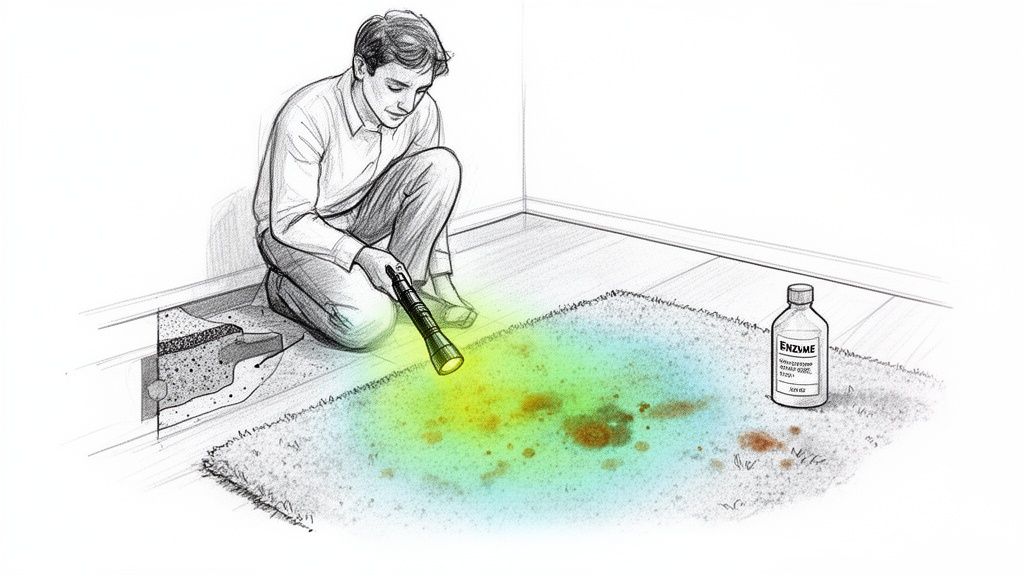
Your most crucial tool for this mission is a UV flashlight, often called a blacklight. What you see on the surface of the carpet is usually just the tip of the iceberg. Underneath, the urine has likely spread out, creating a much bigger contaminated zone in the carpet padding. When you turn off the lights, the salts in dried urine will glow a distinct yellowish-green under the UV beam, revealing the true size and location of every single old spot. Don't be surprised if what looks like a tiny stain on top is actually a dinner-plate-sized problem underneath.
A Deeper Problem Needs a Deeper Saturation
Once you've mapped out the full extent of the damage, it's time to get a bit more aggressive with your treatment. A light spritz of enzyme cleaner just isn't going to cut it here. For these old, set-in messes, you need to apply the cleaner with a very heavy hand.
The whole point is to rehydrate those old uric acid crystals and let the enzymes work their way down as deep as the original urine did. This means you need to saturate the area so thoroughly that the cleaner soaks through the carpet backing, into the padding, and maybe even to the subfloor below.
- Pour, Don't Just Spray: For these tough situations, it’s far more effective to pour the enzymatic cleaner directly onto the marked areas instead of just misting the surface.
- Widen the Perimeter: Always treat an area at least a few inches wider than the spot glowing under the UV light. This ensures you catch any unseen wicking at the edges.
- Patience is a Virtue: Let the cleaner sit and do its job for a good, long while—sometimes several hours. Covering the treated area with plastic wrap can help keep it damp, giving those enzymes maximum time to break down the crystals.
Something to keep in mind: pet urine delamination affects over 40% of carpets in homes with multiple pets. This is where the urine weakens the bonds holding the carpet fibers together. Cat urine, with its high uric acid content, wicks deep into the backing and padding, penetrating up to two inches with each incident. This deep contamination and structural damage is exactly why old odors are so incredibly hard to get rid of. You can read more about how pet urine impacts carpet on carpet-rug.org.
Setting Realistic Expectations for Stubborn Odors
It's really important to be realistic here. Deep contamination is a serious problem, and you might need to repeat the whole saturation and blotting process two or three times over a few days to fully neutralize all the uric acid.
After your final treatment, blot up as much liquid as you possibly can, then let the area air dry completely. A few fans can definitely speed things along. If that smell still hangs around after a few solid attempts, it’s a strong indicator that the urine has soaked all the way down to the subfloor. At that point, you're likely looking at a problem that requires calling in a professional.
When to Call in the Pros (and Why DIY Isn't Always Enough)
You’ve followed every step. You’ve saturated the spot with the best enzyme cleaner you could find and blotted until your arms ached. Yet, that faint, unmistakable odor still hangs in the air, especially on humid days.
It’s a frustrating place to be, and it’s a clear sign the urine has soaked far deeper than any DIY solution can ever hope to reach. It’s time to think about calling a professional. This isn’t about admitting defeat; it’s about recognizing the limits of household tools and protecting your investment in your home.
A professional service brings specialized equipment and knowledge that you just can't replicate with a store-bought bottle and some towels. When the problem has gone beyond the surface, you need a much more powerful solution.
Recognizing the Tipping Point
So, when do you make the call? It really comes down to a few key giveaways. If you find yourself in any of these situations, it’s a strong sign that you’ve done all you can on your own.
- The Smell Returns: This is the most obvious one. If the cat pee smell comes back after you've cleaned, it means the uric acid crystals were never fully broken down. They're just waiting for a little moisture to reactivate.
- The Affected Area is Large: A single, small accident is usually manageable. But if your UV light reveals multiple large spots or widespread contamination, you’re up against a problem that requires professional-grade extraction power.
- You Suspect Subfloor Contamination: If the odor is potent and seems to be rising from the floor itself, the urine has likely soaked right through the carpet and padding into the subfloor. This requires specialized treatment to prevent permanent damage.
A critical factor here is the risk of mold. Deep-seated cat urine that stays damp can lead to mold proliferation in 50% of untreated carpets within just 72 hours. While some cleaners take days to fully dry, a professional low-moisture approach using citrus enzymes can dismantle uric acid in 24-36 hours and dries four times faster, drastically cutting that mold risk.
The Professional Advantage
Professional carpet cleaners don’t just use stronger chemicals; they use entirely different methods. Their commercial-grade hot water extractors—far more powerful than a rental unit—can inject a cleaning solution deep into the carpet padding and then powerfully extract the dissolved urine, cleaner, and moisture.
This process flushes out contaminants that blotting alone always leaves behind. It’s the difference between wiping down the surface and truly pressure-washing the problem from its core. If you're on the fence, you can learn more about whether professional carpet cleaning is worth it for your situation in our detailed guide.
Finally, a quick but important note: if your cat repeatedly urinates outside the litter box even after the area is perfectly clean, it's time to consider a medical cause. This behavior can be a symptom of underlying health issues. It might be a sign of Feline Lower Urinary Tract Disease (FLUTD), which definitely requires a veterinarian's attention.
Still Have Questions About Getting Rid of Cat Pee Smell?
Even when you think you’ve done everything right, some questions always pop up. Let's walk through some of the most common myths and frequently asked questions I hear from homeowners. Getting these answers right can save you a ton of frustration and help you finally kick that cat pee smell to the curb.
Can I Just Use Baking Soda and Vinegar?
I see this recommended all over the internet, and while it might seem like a good idea, it’s really just a temporary fix. A vinegar solution can knock down that initial, sharp ammonia smell on the surface, and baking soda is great for soaking up moisture and some odors.
But here’s the problem: neither of them can actually break down the stubborn uric acid crystals. That's the stuff that makes the smell come back again and again. So, while vinegar and baking soda can act like a mask, they're not a real cure. For a permanent solution that truly gets to the source, you absolutely have to use a proper enzymatic cleaner made specifically to destroy uric acid.
Why Does the Smell Keep Coming Back on Humid Days?
If you've ever cleaned a spot, thought you were done, and then had that awful cat pee smell hit you during a rainy week, you've met uric acid head-on. This is a classic sign that the odor-causing crystals were never fully eliminated. They’re just lying dormant, deep down in your carpet fibers and maybe even the padding.
When the air gets humid, those crystals act like little sponges. They absorb the moisture, which rehydrates them and makes them release that potent ammonia gas all over again. It’s the clearest signal you can get that the first cleaning attempt just didn't go deep enough.
Will a Steam Cleaner Get It Out?
Please, whatever you do, don't do this. Using a steam cleaner on a cat urine stain is one of the biggest mistakes you can make. The intense heat from the steam will essentially "cook" the proteins in the urine, permanently bonding them to the carpet fibers.
This process sets the stain and the odor, making it nearly impossible to remove, even for a professional. Always, always stick to cool water and enzyme cleaners for any pet urine accidents. You don't want to turn a solvable problem into a permanent one.
How Do I Stop This From Happening Again?
Preventing future accidents is a two-step process. First, you have to be certain the odor is 100% gone. A cat's sense of smell is incredibly powerful—way stronger than ours. If even a faint trace of that scent remains, it’s like a flashing neon sign telling them, "This is the spot to go again."
Second, you have to figure out why it happened. A quick trip to the vet is a good first step to rule out medical problems like a urinary tract infection. After that, take a hard look at their environment. Is the litter box spotless? Is it in a quiet, low-stress area where they feel safe? Sometimes, the fix is as simple as reducing stress in the house or providing a more appealing litter box situation.
If you've tried everything and that stubborn odor just won't quit, it’s a strong sign the urine has soaked deep into the padding or even the subfloor. Don't let it win. The experts at Citrus Carpet Cleaning Buford use a specialized low-moisture, citrus-based system that destroys odors at the source without leaving behind sticky, dirt-attracting residues. Get your free "EXACT-imate" and enjoy a fresh, clean home again by visiting us at https://citruscarpetcleaningatlanta.com.