
Before you even think about scrubbing, let’s talk about prep work. I know it’s tempting to jump right in when you find a mildew spot, but taking a few minutes to get set up is probably the most important part of the whole process. Getting it right from the start means you’ll handle the problem safely and effectively, without accidentally making things worse.
Preparing for Safe and Effective Mildew Removal

Look, finding mildew is a bummer, but rushing the cleanup is a huge mistake. When you disturb mildew, those tiny spores go airborne in a flash. They can spread to other parts of your house and, worse, you can breathe them in, which is no good for your lungs. A methodical, safety-first approach is the only way to go.
Prioritize Personal Safety
First things first: protect yourself. Those spores are microscopic, and you don’t want to be inhaling them. Personal protective equipment (PPE) isn't optional here.
- Gloves: Grab a pair of sturdy rubber or nitrile gloves. You don't want cleaning solutions or mildew touching your skin directly.
- Mask: A simple dust mask won't cut it. You need a high-quality N95 respirator mask to properly filter out those fine spores.
- Goggles: Safety goggles are a must. They'll keep any cleaning solution splashes or airborne particles out of your eyes.
Create a Safe Environment
Ventilation is your best friend. Throw open every window and door in that room to get a good cross-breeze going. If you have a box fan, stick it in a window facing out—this will actively pull the contaminated air right out of the room.
Key Takeaway: Never, ever try to clean mildew in a closed-off room. Keeping the air fresh is just as critical as cleaning the carpet. Good airflow protects you and stops the spores from finding a new home somewhere else in the house.
Gather Your Cleaning Arsenal
Getting all your tools and cleaners together beforehand makes everything go so much smoother. You've got a few options, from stuff you probably already have in your pantry to commercial-grade products.
A lot of people have great success with DIY solutions. If you prefer to avoid harsh chemicals, looking into methods for carpet cleaning without chemicals can give you some fantastic, family-safe alternatives.
To help you decide what to use, here's a quick rundown of the most common options.
DIY Mildew Removal Solutions At a Glance
This table breaks down the pros and cons of common household ingredients for tackling carpet mildew. It’s a handy reference to help you pick the right tool for your specific situation.
| Solution | Effectiveness | Best For | Safety Notes |
|---|---|---|---|
| White Vinegar | High | Surface mildew on synthetic & natural fibers | Never mix with bleach; odor dissipates as it dries |
| Baking Soda | Moderate | Absorbing moisture & light odors | Use dry first, then as a paste; non-toxic |
| Borax Solution | High | Deeper cleaning & preventing regrowth | Keep away from pets and children; requires thorough rinsing |
| Commercial Cleaner | Very High | Stubborn, widespread mildew issues | Follow label instructions carefully; test in a hidden spot |
Choosing the right solution depends on how bad the mildew is and what type of carpet you have. For small, surface-level spots, vinegar is often all you need. For more serious issues, a commercial product might be necessary.
Once you’re geared up, the room is aired out, and your cleaner is mixed and ready, you can finally get to work. This careful preparation means you can move forward confidently and get the job done right.
Finding and Figuring Out the Mildew Mess in Your Carpet
Before you even think about grabbing a scrub brush, you need to put on your detective hat. The very first step isn't cleaning—it's getting a handle on just how bad the problem is. And honestly, your nose is usually the first one to sound the alarm.
That unmistakable musty, earthy smell, kind of like a damp basement? That's the calling card of mildew. Don't just brush it off. That odor comes from gases the mildew releases as it grows. If the smell gets stronger in one particular spot, you've found ground zero.
What to Look For
Once you've followed your nose to the source, it's time for a close-up look. Mildew usually looks a little different than that nasty black mold everyone fears. You're typically searching for powdery patches that look gray, white, or sometimes a bit yellowish.
It tends to lie flat on the carpet fibers, almost like someone spilled a bit of flour, rather than having the fuzzy or slimy texture of other molds. A great pro tip is to get a flashlight and hold it almost parallel to the floor. This low-angle light will make any weird textures or discolorations pop in a way that overhead lighting just can't.
You Have to Look Deeper
Here's a hard truth: whatever you see on the surface is probably just the tip of the iceberg. The real problem—and the moisture that's feeding it—is almost always hiding underneath in the carpet padding and even the subfloor. Checking this is non-negotiable.
Carefully pull back a corner of the carpet right where you see the issue. You might need a pair of pliers to get a good grip without tearing anything. Now, take a good look at the carpet's backing, the padding, and the subfloor itself.
Keep an eye out for these tell-tale signs:
- Dark Stains: The padding might be discolored or stained dark from being wet for a long time.
- Dampness: Actually touch it. If the padding or subfloor feels even a little bit damp, you've got a bigger issue than just a surface spill.
- Crumbling Padding: If the padding feels brittle or starts to fall apart, that's a clear signal it's been saturated for a while and is starting to break down.
There's a world of difference between a small spot from a spilled drink you thought you cleaned up and a patch caused by a slow leak in a pipe under the floorboards. The first is a manageable DIY job. The second means you have to fix the leak before any amount of cleaning will do a lick of good.
Knowing how deep the mildew goes determines your entire game plan. If it's just on the surface fibers, the methods we'll talk about next will work. But if that padding and subfloor are soaked and stained, you're looking at a much bigger job—one that might mean replacing the padding or calling in professionals like us at Citrus Carpet Cleaning Buford.
A Practical Guide to Cleaning Mildew from Carpet
Okay, you've figured out what you're up against. Now it's time to get to work. This is where we get hands-on and walk through how to actually remove mildew from carpet without wrecking it in the process. The secret isn't scrubbing harder; it's about being smart and methodical, tackling the problem right at the source.
Your very first step is a crucial one: vacuum the area thoroughly. But don't just grab any old vacuum. You absolutely need to use one with a HEPA filter. This isn't just a fancy feature—a HEPA filter is designed to trap microscopic particles like mildew spores, stopping them from getting shot back into the air and spreading all over your house.
Applying Your Chosen Cleaning Solution
Once the loose spores are gone, you're ready to tackle the stain. Whether you're using a simple vinegar solution or a store-bought anti-fungal carpet cleaner, how you apply it is everything. The biggest mistake I see people make is soaking the carpet.
Drenching the spot feels like you're being more effective, but it's a huge mistake. All that extra moisture just sinks into the carpet padding and the subfloor below, creating the perfect damp environment for mildew to come roaring back. You have to use a lighter touch.
Pro Tip: Always put the cleaning solution on your cloth or soft-bristled brush first, not directly on the carpet. This gives you total control over the amount of liquid you're using and is the best way to avoid over-wetting the area.
Using your soft brush, gently work the cleaner into the carpet fibers. Small, circular motions are best. Your goal is just to agitate the mildew and lift it up, not to scrub it deeper into the backing. For more great advice on cleaning carpets in tough, moisture-prone environments, this DIY guide to cleaning boat interior, including carpet is surprisingly helpful.
Let your cleaning solution sit for about 10-15 minutes. This "dwell time" gives the active ingredients a chance to really break down the mildew.
Lifting the Grime and Odor
After the solution has done its job, it's time to get it out. Don't rub! Instead, grab a clean, dry cloth or some paper towels and blot the spot firmly. Press straight down to soak up the moisture and the gunk it has lifted. Move to a clean section of your cloth and do it again. You should start to see the mildew transferring from your carpet to the cloth.
This blotting action is what actually pulls the moisture and the contaminants out of the carpet fibers.
Here’s that quick visual guide to remind you of the key identification steps before you dive into the cleaning part.
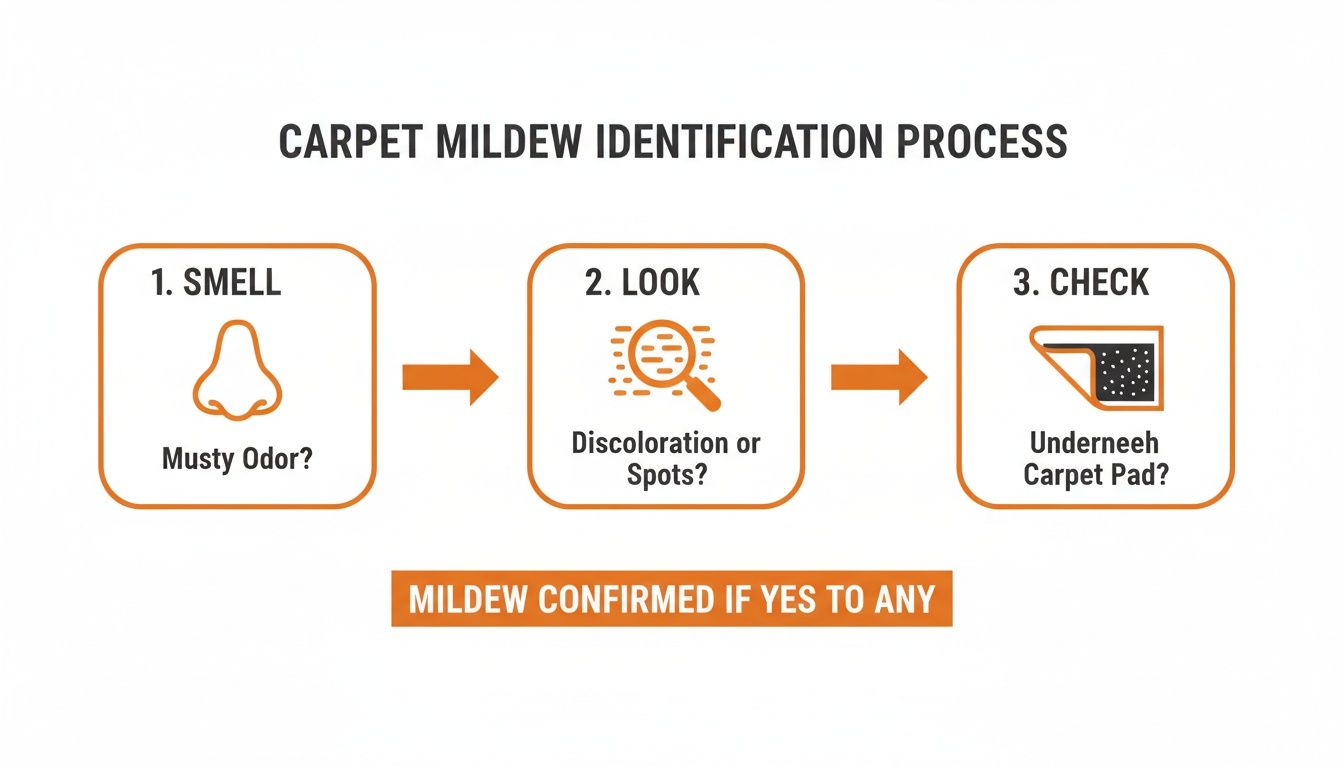
This simple flow—Smell, Look, Check—highlights why it's so important to assess the situation before you start spraying cleaners. There's a reason the professional mold remediation service market was valued at USD 1.2 billion globally in 2023. Carpets just love to trap moisture, and with mold allergies affecting nearly 20 million Americans every year, people are realizing just how critical proper cleaning is.
The Critical Steps for Drying and Deodorizing
So, you've scrubbed away the visible mildew. That's a great start, but honestly, it's only half the battle. The real victory is getting every last bit of moisture out of that carpet.
This is where most DIY efforts to remove mildew from carpet go wrong. Mildew loves dampness, and if you leave any behind, it will come back. Simply letting the area "air dry" is a recipe for disaster. All that moisture trapped deep in the padding and subfloor isn't going anywhere on its own.
Aggressively Dry the Area
To really win this fight, you have to make the environment completely hostile to mildew. That means actively yanking moisture out of the carpet, the pad, and the air itself.
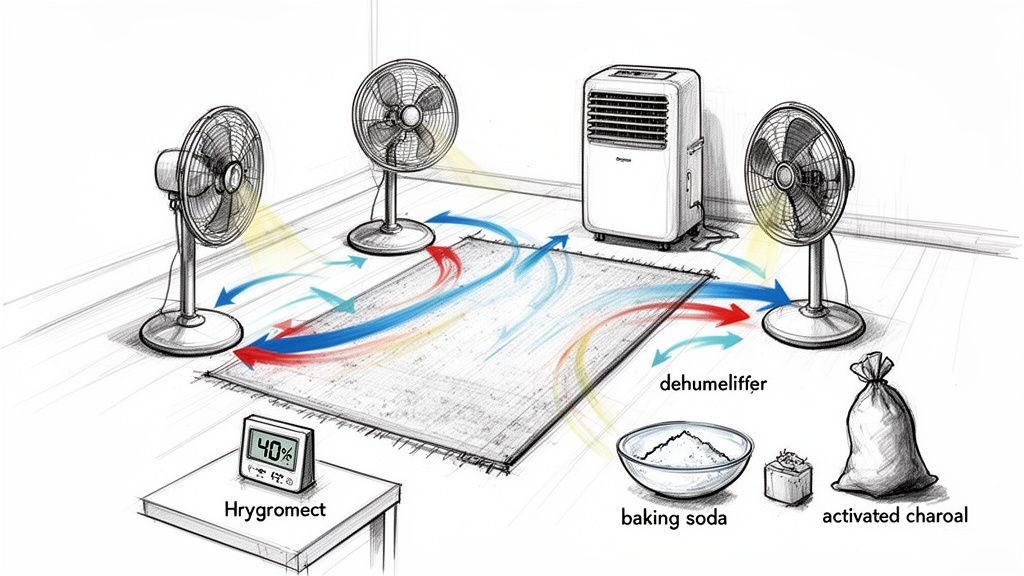
- Fans Are Your Best Friend: Grab a few box fans and get a strong cross-breeze going. Don't just point them at the wet spot; angle them to blow across the surface. This lifts the damp air up and away from the carpet fibers.
- Bring in a Dehumidifier: This is your secret weapon. Park a dehumidifier right next to the damp area and let it run nonstop for at least 24 to 48 hours. This machine is a workhorse, pulling water vapor straight out of the air, which in turn sucks the moisture from your carpet, the padding, and even the wood subfloor.
A Critical Reminder: Mildew can start growing on a damp surface in as little as 24 hours. Don't stop just because the top of the carpet feels dry. The real enemy is the hidden moisture lurking below.
It's also worth knowing just how much water we're talking about. Carpet is like a giant sponge; it can hold 4-5 times its own weight in water after a spill. This is why our professional-grade extraction equipment is so critical—it physically removes up to 97% of that trapped moisture and the mildew spores along with it, which dramatically speeds up the whole process. For a deeper dive into drying times, our guide on how long for carpet to dry has some great insights.
Eliminate Lingering Odors
Even after the carpet is bone-dry, you might still notice that stubborn, musty smell. It’s the final ghost of mildew past, and we need to kick it out for good. Luckily, you don't need harsh chemicals for this part.
Baking soda is a fantastic—and cheap—natural deodorizer. Sprinkle a very generous layer over the entire area and just let it sit overnight. The baking soda will absorb and neutralize those stinky organic compounds causing the odor.
The next morning, vacuum it all up. Make sure you're using a vacuum with a clean filter to get the best results. If the smell is extra stubborn, you can repeat the process. This final step ensures your carpet is not just clean to the eye, but smells genuinely fresh, too.
Smart Strategies to Keep Mildew From Coming Back
Look, getting mildew out of your carpet is a huge win, but the job isn't really done. Now you have to make sure it never comes back. Preventing mildew is all about making your home an unwelcome place for it to grow. That means going straight for its biggest weakness: moisture.
The absolute best long-term plan is to get your indoor humidity under control. Mildew loves it when humidity gets above 60%, so keeping your home somewhere between 30% and 50% is your goal. For damp spots like basements or during those sticky Buford summers, a good dehumidifier isn't just nice to have—it's a necessity.
Get a Handle on Environmental Moisture
Beyond just the general humidity in the air, you’ve got to be on the lookout for specific moisture threats. Spills are a big one, and you have to act fast. Don't just give it a quick dab; get in there, blot like you mean it, and then aim a fan at the spot to make sure the carpet padding underneath gets completely dry.
Good old-fashioned ventilation is also a game-changer, especially in rooms that tend to get damp.
- Use Your Fans: Always, always run the exhaust fan in the bathroom during and after a shower.
- Let in Fresh Air: Crack a window every now and then. Getting that stale, moist air out and fresh air in makes a huge difference.
- Play Detective: Regularly check around windows, under sinks, and near appliances for any slow drips. A tiny, unnoticed leak can easily saturate your carpet over time.
It’s also smart to think about the hidden moisture sources. A lot of people don't realize that their HVAC system plays a huge role in this, so it's worth understanding why your air conditioner smells musty. A clean, well-maintained AC is your best friend in the fight against humidity.
Build Some Proactive Cleaning Habits
Finally, a couple of simple, everyday habits can save you a world of trouble down the road. Put high-quality doormats at every single door. You'd be amazed how much moisture and gunk they can trap before it ever gets tracked onto your carpets.
My Two Cents: The best defense is a good offense. When you schedule a professional deep cleaning at least once a year, you're doing more than just getting the dirt out. We extract that deep-down moisture and organic grime that mildew spores feed on. It’s like hitting the reset button for your carpet's defenses.
When you put all these steps together, you're essentially turning your home into a fortress against mildew. By managing the humidity, jumping on spills, and keeping things clean, you’re not just fixing a problem—you’re stopping it before it even gets a chance to start.
Knowing When to Call a Carpet Cleaning Professional
Listen, DIY methods are fantastic for small, manageable spots. I’m a big fan of tackling what you can. But knowing your limits is absolutely key to protecting your home and your health from a bigger problem down the road.
Sometimes, the best way to remove mildew from carpet is to simply pick up the phone. A little surface-level issue is one thing. A widespread, musty-smelling problem? That requires professional-grade power and expertise.
There are some clear-as-day signs that it’s time to call in the experts. If you're dealing with a situation that feels overwhelming, it probably is. Trust your gut on this one.
When the Problem Is Too Big to Handle
Certain scenarios are just beyond what household cleaners and a bit of elbow grease can fix. If you run into any of these red flags, it's time to bring in a professional service like Citrus Carpet Cleaning Buford.
- The Mildew Patch Is Large: If you're looking at an affected area bigger than a few square feet, you’re in over your head. Trying to DIY a large patch often just spreads the spores around and won't get deep enough to kill the root of the problem.
- The Odor Won't Quit: That stubborn musty smell that hangs around even after you've cleaned? That’s your sign. It means the mildew is still alive and kicking down in the carpet padding or even the subfloor.
- You Suspect Deep Saturation: This is a big one. If you can pull back a corner of the carpet and see that the padding underneath is damp, discolored, or even crumbling, you need to stop right there. That’s a job for a pro, period.
Expert Insight: The equipment we use makes all the difference. Our hot water extraction machines don't just clean the surface. They use high-pressure hot water and incredibly powerful suction to literally pull the spores, dirt, and deep-seated moisture right out of the carpet and padding. A rental machine from the grocery store just can't replicate that kind of power.
The Professional Advantage
When you hire a real professional, you're not just getting someone to treat the visible symptoms. We diagnose and solve the underlying issue. We find out where the moisture is coming from in the first place, giving you a permanent solution instead of a temporary fix that will just come back.
We also have access to commercial-grade, professional antimicrobial treatments that safely kill mildew and prevent its return without damaging your carpet fibers.
Carpets are like giant sponges. They absorb a huge amount of dust and allergens, which is why getting every last bit of mildew out is so vital for your home's air quality. In fact, industry reports show that DIY methods can fail in 40% of severe cases, which really highlights why professional help is so critical for any extensive contamination. If you're curious, you can find more insights on mildew remover trends over on factmr.com.
Ultimately, figuring out if professional carpet cleaning is worth it comes down to one thing: protecting your investment and your family's health. For widespread or recurring mildew, calling us isn't just a convenience—it's an essential step toward a truly clean and safe home.
Got Questions About Carpet Mildew? We've Got Answers.
When you're staring down a patch of mildew on your carpet, questions start flying. It's completely normal to feel a bit lost—you want to fix the problem without accidentally making things worse. Let's clear up some of the most common questions we hear from homeowners.
Can I Just Nuke it With Bleach?
Please don't. This is one of the most common—and most damaging—mistakes people make. While it’s true that bleach is a beast when it comes to killing germs, it’s an absolute disaster for your carpet. You’ll almost certainly be left with a permanent, bleached-out spot that’s way more noticeable than the mildew ever was.
It gets worse. Beyond just stripping the color, bleach can actually eat away at the carpet's latex backing, making the fibers brittle and causing the whole area to fall apart over time. Just stick to safer, proven solutions. White vinegar, baking soda, or a cleaner made specifically for carpets will get the job done without destroying your floor.
A Word of Caution: Even "safe" cleaners like vinegar can become food for new mildew if you don't dry the area completely. Cleaning is only half the battle; aggressive, thorough drying is what truly solves the problem and keeps it from coming right back.
Is This Mildew or Something Worse, Like Mold?
It's a great question, and here’s the easiest way to think about it: mildew is a type of mold, just the less scary, surface-level kind. It usually looks like a powdery patch of gray or white stuff that hasn't burrowed in too deep. Mildew is typically the result of temporary dampness, like a spill that wasn't cleaned up quickly or a room with high humidity.
The other, nastier types of mold are a different story. They often look fuzzy or even slimy and come in darker shades of green and black. The real difference is that these guys aren't just sitting on the surface. They dig deep into the carpet padding and can even compromise the subfloor. If you see that, you're not looking at a simple cleaning job anymore; you're looking at a serious, underlying moisture problem that needs to be addressed immediately.
How Fast Does This Stuff Actually Grow?
Way faster than most people think. Given the right conditions—a little moisture, some warmth, and not much airflow—mildew can start sprouting on a damp carpet in as little as 24 to 48 hours.
That’s a shockingly small window, and it's why you can't afford to wait. A forgotten spill or a slow leak isn't just a minor inconvenience; it's a ticking clock. Drying the spot completely isn't just a good idea, it's the single most critical step you can take to stop a full-blown mildew invasion in your home.
If you're in Buford and dealing with a mildew mess that just won't quit, don't let it spread. Contact Citrus Carpet Cleaning Buford for a professional, deep cleaning that tackles the problem at its source, leaving your home healthy and smelling fresh. Schedule your EXACT-imate today!